French Press Guide: A Comprehensive Manual
Embark on a journey to exceptional coffee! This guide unlocks the secrets of the French press, exploring techniques for brighter, clearer, or sweeter brews.
Discover how water temperature, grind size, and bloom times impact flavor, tailoring each cup to your preference—whether using a Chemex or Aeropress.
Achieve a well-defined cup with a 1:15 ratio, a 1:3 bloom for 45 seconds, and a total brew time around 5:30, optimizing for light roasts and natural processes.
The French press, also known as a cafetière, offers a remarkably simple yet profoundly satisfying method for brewing coffee. Unlike drip machines or pour-over systems, the French press relies on full immersion – the coffee grounds steep directly in hot water, extracting a rich and full-bodied flavor profile. This manual brewing process grants you complete control over key variables, allowing for personalized adjustments to achieve your ideal cup.
Its enduring popularity stems from its accessibility and the quality of coffee it produces. Whether you’re a seasoned coffee aficionado or a curious beginner, mastering the French press unlocks a world of aromatic and flavorful possibilities. This guide will demystify the process, providing a comprehensive overview from equipment selection to advanced brewing techniques, ensuring consistently delicious results. Prepare to elevate your coffee ritual!
What is a French Press and Why Use One?
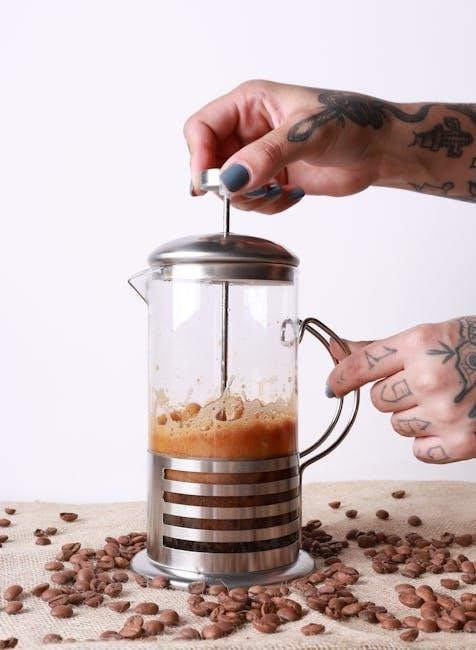
A French press is a coffee brewing device consisting of a cylindrical beaker, typically made of glass or stainless steel, and a plunger fitted with a mesh filter. Hot water and coarsely ground coffee are combined within the beaker, allowed to steep, and then the plunger is slowly depressed to separate the grounds from the brewed coffee.
Why choose a French press? It delivers a uniquely full-bodied and flavorful cup due to the immersion brewing method, retaining more of the coffee’s natural oils and sediments. This contrasts with paper filters that absorb these elements. It’s also incredibly versatile – capable of brewing tea and even cold brew. Furthermore, it’s a relatively inexpensive and portable brewing solution, requiring no electricity and minimal cleanup, making it ideal for home or travel.
History of the French Press
While often called a “French” press, its origins are surprisingly Italian! The design traces back to Attilio Calimani, an Italian designer who patented a coffee brewing method utilizing a mesh filter in 1929. This early version, however, didn’t gain widespread popularity.
The modern French press as we know it was refined and popularized by a French inventor, Maurice Chevalier, in the 1950s. He improved upon Calimani’s design, making it more user-friendly and aesthetically pleasing. Its simplicity and ability to produce a rich, flavorful brew quickly gained traction in Europe and eventually spread globally.
Throughout the late 20th and early 21st centuries, the French press experienced waves of renewed interest, becoming a staple in specialty coffee culture and a favorite among coffee enthusiasts seeking a hands-on brewing experience.
Essential Tools & Equipment
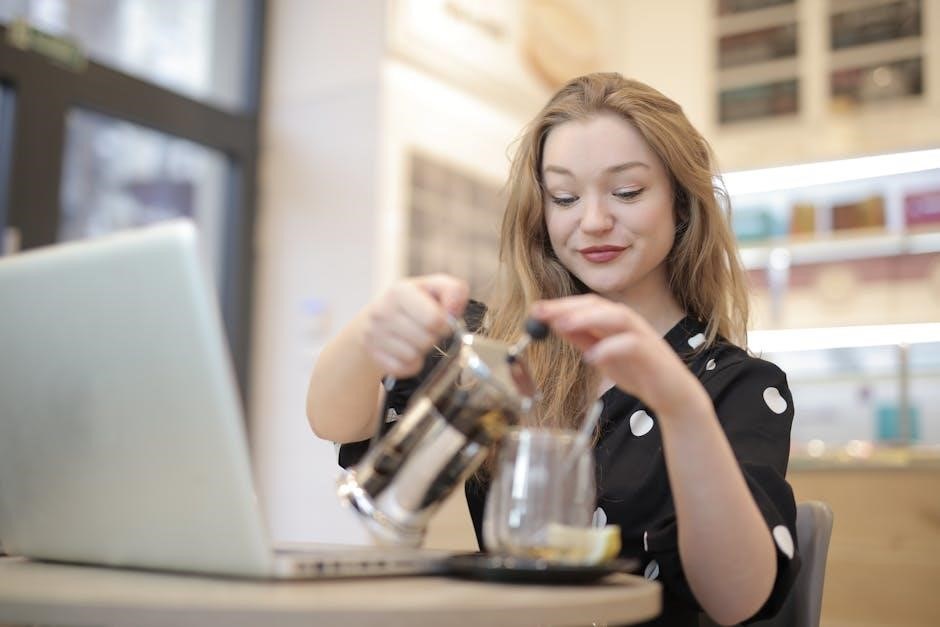
To begin your French press journey, gather a grinder, French press, kettle, scale, and quality beans—essential for crafting exceptional coffee at home, consistently.
The French Press Itself: Sizes and Materials
French presses come in a delightful array of sizes, catering to individual needs and group servings; You’ll find options ranging from compact 3-cup (12oz) models, perfect for solo coffee enthusiasts, all the way up to larger 8-cup (34oz) presses, ideal for families or entertaining guests. Consider your typical consumption when selecting a size.
Materials commonly used in French press construction include glass, stainless steel, and plastic. Glass carafes offer visual appeal, allowing you to observe the brewing process, but require careful handling due to their fragility. Stainless steel presses are incredibly durable and retain heat exceptionally well, making them a popular choice. Plastic models are lightweight and affordable, though they may not offer the same heat retention or aesthetic appeal as glass or steel.
The quality of the mesh filter is also crucial; a fine mesh ensures minimal sediment ends up in your cup. Double-walled stainless steel presses provide superior insulation, keeping your coffee hotter for longer.
Coffee Grinder: Burr vs. Blade
The grinder is arguably as important as the French press itself! When it comes to grinding coffee, the debate centers around burr grinders versus blade grinders. Blade grinders, resembling a spice grinder, chop the beans unevenly, resulting in inconsistent extraction and potentially bitter flavors. They are generally more affordable, but compromise quality.
Burr grinders, on the other hand, crush the beans between two revolving abrasive surfaces (burrs), producing a uniform grind size. This consistency is vital for optimal French press brewing, allowing for even extraction and a smoother, more flavorful cup.
Burr grinders come in conical and flat burr varieties, both offering superior results compared to blade grinders. Investing in a burr grinder, even a hand-crank model, will dramatically elevate your French press experience.
Coffee Beans: Choosing the Right Roast
Selecting the right coffee bean roast is crucial for a satisfying French press experience. Generally, medium to dark roasts excel in a French press due to their ability to withstand the immersion brewing method. Darker roasts offer bold, robust flavors with lower acidity, while medium roasts provide a balanced profile with more nuanced notes.
However, don’t shy away from lighter roasts! As demonstrated with natural processed Ethiopian beans, lighter roasts can shine with proper technique – higher water temperatures and adjusted grind sizes are key.
Experimentation is encouraged! Consider the origin and processing method alongside the roast level to discover your perfect cup. Freshly roasted beans, ideally used within a few weeks of roasting, will always deliver the best flavor.
Water Kettle: Temperature Control is Key
Precise water temperature is paramount for optimal French press brewing. While boiling water might seem ideal, it can scorch the coffee grounds, resulting in a bitter taste. A kettle with temperature control allows you to heat water to the precise degree needed for your chosen roast.
For lighter roasts, aiming for 205°F (96°C) or even just off-boil during the bloom phase can help extract their delicate flavors. Darker roasts generally benefit from slightly cooler temperatures, around 200°F (93°C), to prevent over-extraction.
Consistent temperature throughout the brewing process is also vital. A gooseneck kettle provides greater pouring control, ensuring even saturation of the coffee grounds and a more balanced extraction.
Kitchen Scale: For Precise Measurements
Achieving consistent results with a French press hinges on accurate measurements, and a kitchen scale is indispensable. Relying on scoops or estimations introduces variability, impacting the final flavor profile. A scale ensures you use the correct coffee-to-water ratio every time.
As a starting point, a 1:15 ratio (e.g., 15 grams of coffee to 225 grams of water) is a good foundation, but experimentation is encouraged. Weighing both coffee beans and water guarantees repeatability, allowing you to fine-tune your brew based on taste preferences.
Digital scales with gram measurements offer the greatest precision. This level of accuracy is particularly crucial when exploring different beans and grind sizes, enabling you to isolate variables and optimize your brewing process.
The Brewing Process: Step-by-Step
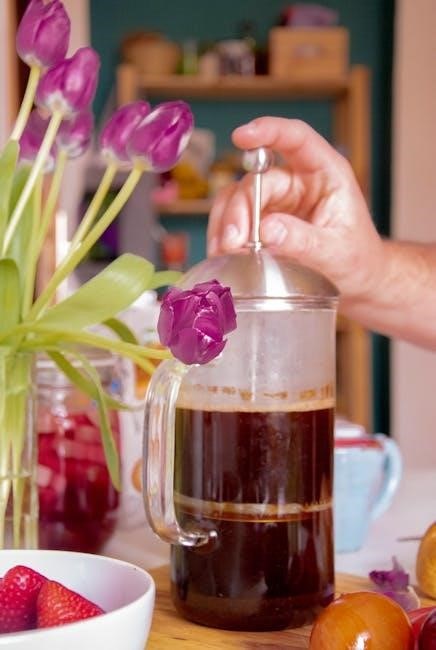
Mastering French press coffee involves a precise sequence: grind beans, heat water, bloom the grounds, pour, stir, brew, press, and finally, savor the rich result!
Step 1: Grind the Coffee Beans
The foundation of exceptional French press coffee lies in the quality and consistency of your grind. Avoid blade grinders, which produce an uneven grind with fine dust and larger chunks; instead, invest in a burr grinder. For a French press, a coarse grind is crucial – think about the texture of sea salt.
A grind that’s too fine will slip through the filter, resulting in a muddy cup, while a grind that’s too coarse will lead to under-extraction and a weak, sour brew. Experimentation is key!
As a starting point, consider a setting of 17-18 on an Encore grinder, especially when working with natural processed Ethiopian beans. Remember, the ideal grind size can vary depending on your specific grinder and the type of bean you’re using, so adjust accordingly to unlock the full flavor potential.
Step 2: Heat the Water to the Ideal Temperature
Water temperature is a critical, often overlooked, element in French press brewing. While boiling water might seem ideal, it can actually scorch the coffee grounds, leading to a bitter taste. The sweet spot generally falls between 195-205°F (90-96°C).
For lighter roasts, like the Ethiopian natural process discussed, leaning towards the higher end – even just off boil for the bloom – is beneficial. Lighter roasts require more heat to extract their full flavor profile.
If you don’t have a temperature-controlled kettle, bring the water to a boil and then let it sit for about 30-60 seconds before pouring. Precise temperature control isn’t absolutely essential, but it significantly enhances the consistency and quality of your brew.
Step 3: Add Coffee Grounds to the French Press
Now, carefully add your freshly ground coffee to the pre-heated French press. The recommended coffee-to-water ratio is a crucial starting point, with a 1:15 ratio being a solid foundation – for example, 15 grams of coffee to 225 grams of water.
Adjust this ratio later to fine-tune the strength to your liking. Ensure the grounds are evenly distributed across the bottom of the press. A kitchen scale is invaluable for achieving this precision, eliminating guesswork and promoting consistent results.
Remember, the grind size significantly impacts extraction; a grind around 17-18 on an Encore grinder is a good starting point for a Chemex-style brew, but experimentation is key.
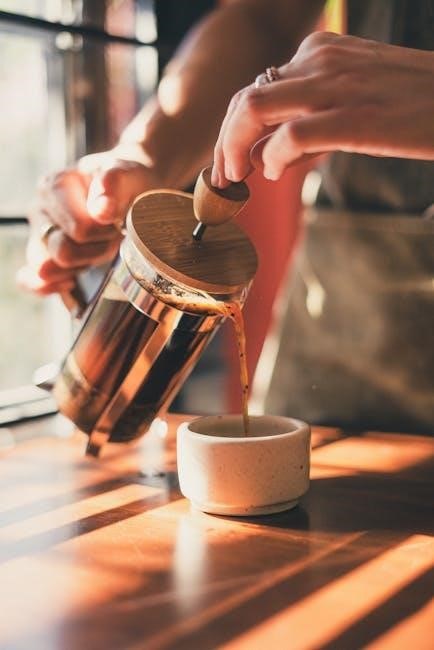
Step 4: The Bloom: Pre-Infusion for Flavor
Initiate the bloom by pouring roughly twice the amount of water as coffee grounds – for 15 grams of coffee, use approximately 30 grams of water – over the grounds. This initial pour saturates the coffee, releasing trapped carbon dioxide.
Allow the coffee to “bloom” for 45 seconds. You’ll observe bubbling as the gases escape, a sign of freshness and proper degassing. Light roasts particularly benefit from a hotter bloom temperature, potentially using water just off the boil (around 205°F or higher).
Gently swirl the French press a few times during the bloom to ensure all grounds are evenly saturated, maximizing flavor extraction and preparing for the full infusion.
Step 5: Pouring the Remaining Water
After the 45-second bloom, slowly pour the remaining hot water into the French press, aiming for a consistent and even saturation of the coffee grounds. Following a 1:15 coffee-to-water ratio (e.g., 225 grams of water for 15 grams of coffee) is a good starting point.
Observe the coffee bed; wait until it becomes visible before adding the final portion of water. This ensures a more uniform extraction. A 60-second pour is a common approach, but adjust based on your preferred brewing style.
Gentle stirring with a spoon, similar to the Hoffmann V60 method, can further aid in even saturation and extraction, contributing to a balanced and flavorful cup.
Step 6: Stirring and Brewing Time
Following the addition of the remaining water, gently stir the coffee grounds to ensure complete saturation and even extraction. This step is crucial for unlocking the full flavor potential of your beans. A thorough, yet gentle, stir promotes consistent contact between the water and coffee.
Allow the coffee to brew undisturbed for approximately 4 to 5 minutes. Total brew time can vary depending on your roast level and personal preference; lighter roasts often benefit from slightly longer brewing periods.
Don’t obsess over precise timing, as achieving a great taste is paramount. Observe the brew; a visible coffee bed indicates readiness for the next step.
Step 7: Pressing the Plunger Slowly
Once the brewing time is complete, slowly and steadily press the plunger down. Resist the urge to force it; a smooth, controlled descent is key to avoiding sediment disruption and ensuring a clean cup. If you encounter significant resistance, slightly lift the plunger and try again at a gentler pace.
The goal is to separate the brewed coffee from the grounds without agitating them. A slow press minimizes the amount of fine particles that pass through the filter.
Pressing should take around 20-30 seconds. Stop just before reaching the very bottom to avoid disturbing any settled sediment.
Step 8: Serving and Enjoying Your Coffee
Immediately after pressing, pour the coffee into your cup or a preheated serving vessel. Leaving the brewed coffee in the French press, even after pressing, will result in continued extraction and potentially a bitter taste due to prolonged contact with the grounds.
Savor the rich aroma and full-bodied flavor of your freshly brewed coffee! Take a moment to appreciate the nuances of the roast and origin.
Experiment with different additions like cream, milk, or sweeteners to personalize your experience. Remember, the “right” way to enjoy coffee is the way you enjoy it most!
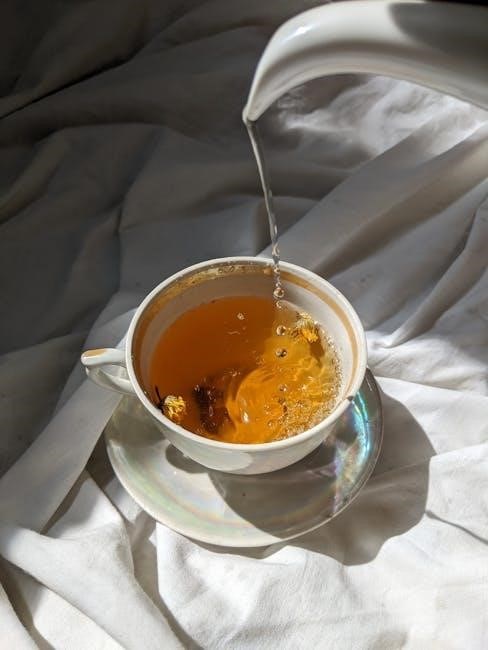
Refining Your Brew: Advanced Techniques
Elevate your French press experience! Adjust coffee-to-water ratios, explore water quality impacts, and fine-tune grind sizes for optimal flavor profiles with each bean.
Coffee-to-Water Ratio: Finding Your Sweet Spot
The coffee-to-water ratio is paramount in French press brewing, directly influencing strength and flavor. A standard starting point is a 1:15 ratio – for example, 15 grams of coffee to 225 grams of water. However, this is merely a guideline; personal preference reigns supreme!
Experimentation is key. If your coffee tastes weak, incrementally increase the coffee amount (e.g., to a 1:14 or 1:13 ratio). Conversely, if it’s too strong or bitter, reduce the coffee (1:16 or 1:17).
Consider the bean’s roast level. Lighter roasts often benefit from a slightly higher ratio to extract their nuanced flavors, while darker roasts may require a lower ratio to avoid excessive bitterness.
Precise measurements, using a kitchen scale, are crucial for consistent results. Don’t rely on scoops or estimations! Small adjustments can yield significant improvements in your final cup, unlocking the full potential of your chosen beans.
Water Quality and its Impact on Taste
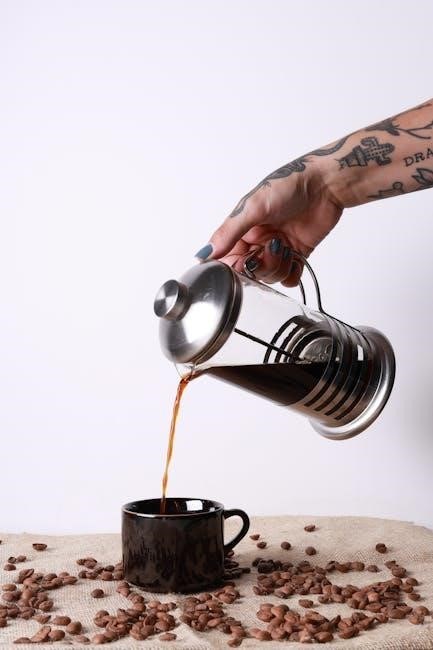
Often overlooked, water quality dramatically impacts the final flavor profile of your French press coffee. Coffee is approximately 98% water, so using subpar water will inevitably result in a subpar brew. Avoid distilled or heavily softened water, as they lack the minerals necessary for optimal extraction.
Filtered water is a significant improvement over tap water, removing chlorine and other impurities that can mask the coffee’s delicate aromas and flavors. Spring water is another excellent option, naturally containing beneficial minerals.
Water hardness – the mineral content – also plays a role. Ideally, aim for water with moderate hardness. Experiment with different water sources to discern what best complements your chosen coffee beans. Remember, clean, fresh water is the foundation of a delicious cup!
Grind Size Adjustment for Different Beans
Achieving the perfect grind size is crucial for French press success, and it’s not one-size-fits-all. Different beans require adjustments to maximize flavor extraction. Generally, a coarse grind is preferred – resembling breadcrumbs – to prevent sediment from passing through the filter.
However, lighter roasted beans often benefit from a slightly finer grind, as they are denser and require more surface area for extraction. Conversely, darker roasts, being more porous, may need a coarser grind to avoid bitterness.
Experimentation is key! If your coffee tastes bitter, coarsen the grind. If it tastes weak or sour, try a finer grind. A burr grinder provides consistent results, allowing for precise adjustments to unlock each bean’s full potential.
Pre-Heating the French Press
Often overlooked, pre-heating your French press is a simple step with a significant impact on brew quality. Warming the glass carafe prevents a drastic temperature drop when you introduce hot water, ensuring consistent extraction throughout the brewing process.
To pre-heat, simply fill the press with hot tap water, swirl it around to warm the glass evenly, and then discard the water before adding your coffee grounds. This maintains a stable brewing temperature, crucial for optimal flavor development, especially with lighter roasts.
Consistent temperature is vital. A cold press can shock the grounds, leading to uneven extraction and a less flavorful cup. Don’t skip this step – it’s a small effort for a noticeably better brew!
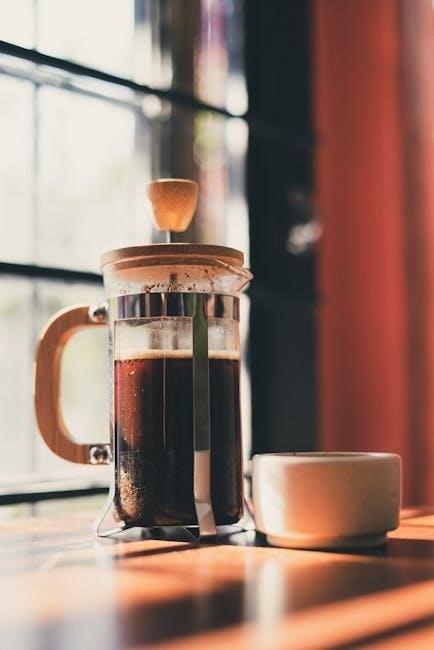
Troubleshooting & Tips
Adjust grind size and brew times to optimize flavor profiles for different beans; bitterness or weakness often signals a need for refinement in technique.
Coffee Tastes Bitter: Common Causes & Solutions
A bitter taste in your French press coffee is a common issue, often stemming from over-extraction. This happens when the water is in contact with the coffee grounds for too long, or the water temperature is excessively high. Coarser grounds can help, reducing the surface area exposed to the water and slowing extraction.
Conversely, using too fine a grind can also contribute to bitterness. Ensure your grinder is set appropriately for French press – a coarse, even grind is ideal. Water temperature is crucial; aim for around 200°F (93°C). Boiling water can scorch the grounds, leading to a bitter flavor.
Finally, consider the coffee beans themselves. Darker roasts naturally have more bitterness. Experiment with lighter roasts or different bean origins to find a profile you enjoy. Cleaning your French press thoroughly after each use also prevents stale coffee oils from contributing to bitterness.
Coffee Tastes Weak: Adjusting Your Technique
If your French press coffee lacks the desired strength, several adjustments can be made. The most common cause is an insufficient coffee-to-water ratio. Increase the amount of coffee grounds used for the same volume of water. A starting point is a 1:15 ratio (coffee to water), but experiment to find your sweet spot.
Ensure your grind isn’t too coarse. While a coarse grind is essential for French press, excessively coarse grounds will under-extract, resulting in a weak brew. Also, verify your water temperature is hot enough – ideally between 195-205°F (90-96°C).
A shorter brew time can also contribute to weakness. Extend the brewing period by a minute or two. Finally, confirm a thorough bloom, allowing the coffee to degas properly, maximizing flavor extraction.
Sediment in Your Cup: Minimizing the Sludge
A small amount of sediment is normal with French press coffee, but excessive sludge can detract from the experience. To minimize it, focus on grind size – ensure it’s consistently coarse, avoiding fine particles. A burr grinder is superior to a blade grinder for achieving this consistency.
Press the plunger slowly and steadily, avoiding forceful downward motion that can disturb the grounds. After pressing, avoid swirling or agitating the press before pouring.
Decant the coffee immediately after pressing to prevent further extraction and sediment settling. Some advocate gently scooping off the foam on top before pressing, as it often contains fine particles. Accepting a small amount of sediment is part of the French press charm!
Cleaning and Maintenance of Your French Press
Regular cleaning is crucial for maintaining your French press and ensuring optimal coffee flavor. After each use, disassemble the press completely – glass beaker, filter assembly, and lid. Discard used coffee grounds; avoid pouring them down the drain as they can cause clogs.
Wash all components with warm, soapy water. Pay close attention to the filter screen, ensuring all coffee residue is removed. For stubborn stains, a mild abrasive cleaner can be used on the glass beaker, but avoid harsh chemicals.
Periodically, deep clean the filter assembly by soaking it in a solution of vinegar and water to remove built-up oils. Ensure all parts are thoroughly rinsed and dried before reassembling.

Beyond the Basics: Exploring Variations
Expand your horizons! Discover cold brew possibilities and explore using your French press for delightful tea infusions, unlocking new beverage experiences effortlessly.
Cold Brew French Press Method
The French press isn’t limited to hot coffee; it excels at cold brew! This method yields a remarkably smooth, low-acid concentrate perfect for warmer days. Begin with coarsely ground coffee – even coarser than for hot brewing – and a generous coffee-to-water ratio, typically 1:8 or even 1:4 for a stronger concentrate.
Combine the grounds and cold, filtered water directly in the French press. Gently stir to ensure all grounds are saturated. Avoid pressing the plunger down; instead, cover the press and refrigerate for 12-24 hours, allowing ample time for extraction.
After steeping, slowly press the plunger down to separate the grounds. The resulting concentrate can be enjoyed immediately diluted with water or milk, or stored in the refrigerator for up to two weeks. Experiment with steep times to find your ideal strength and flavor profile!
French Press for Tea Brewing
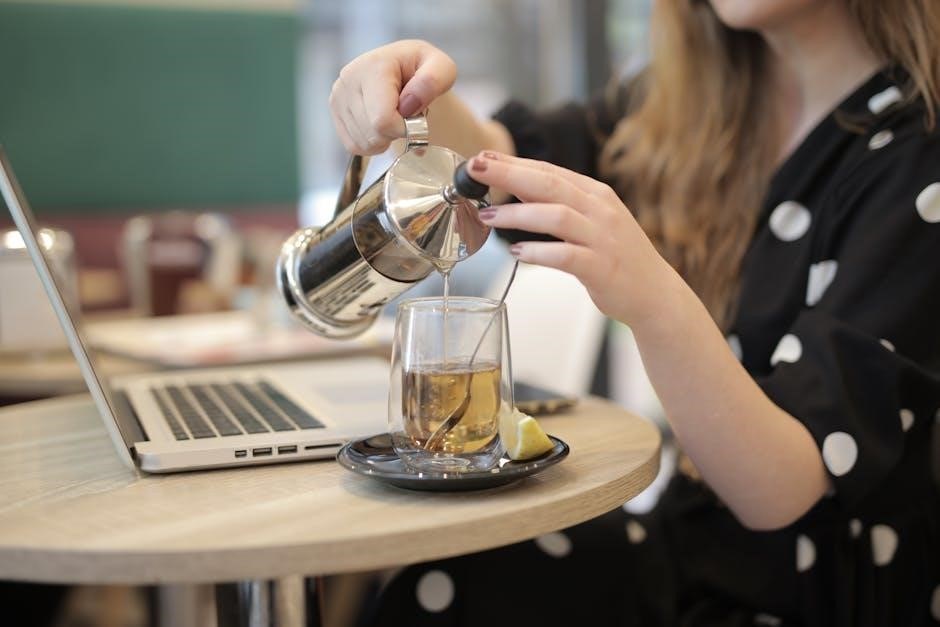
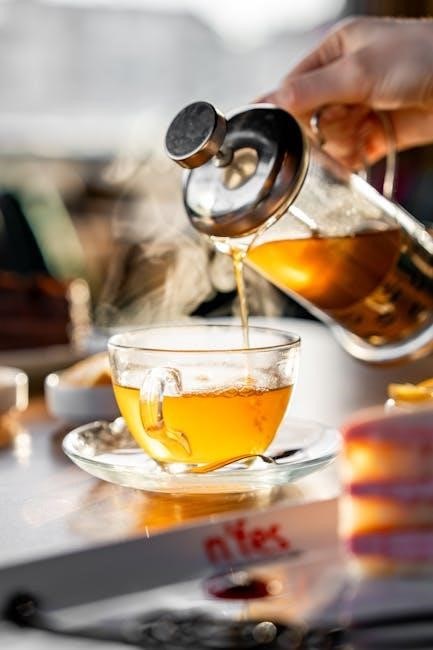
Beyond coffee, the French press is a surprisingly versatile tool for brewing loose-leaf tea! Its full immersion method allows tea leaves to unfurl completely, releasing a richer, more nuanced flavor compared to traditional tea bags or infusers. The key is adjusting brewing parameters to suit the specific tea type.
For delicate green or white teas, use cooler water (around 175°F/80°C) and a shorter steep time (2-3 minutes) to prevent bitterness. Black teas and herbal infusions can handle hotter water (212°F/100°C) and longer steeping (5-7 minutes).
Add loose-leaf tea directly to the French press, pour in the appropriate temperature water, and steep. Gently press the plunger down after the steeping time to separate the leaves, preventing over-extraction. Enjoy a full-bodied, flavorful cup of tea!